
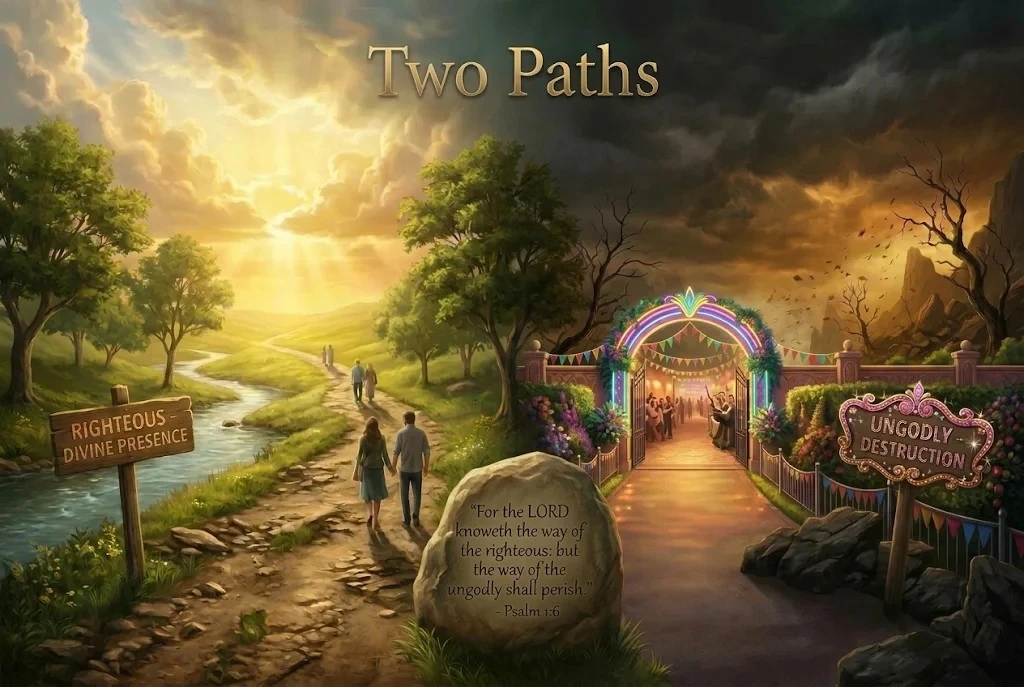
Two Paths: Righteous and Unglodly
The Two Paths: Righteous and Ungodly
Psalm 1:6 “For the LORD knoweth the way of the righteous: But the way of the ungodly shall perish.”
This psalm has been placed as the introductory psalm, and for good reason. The Book of Psalms is the official Psaltery of Israel. It is the record of 150 declarations of praise and worship in which the people of Israel proclaimed their gratefulness, their anxieties, their confidence, their expectations, and their love.
Some of the psalms speak of God’s mercy and grace to sinners unworthy of His compassion and careful attention. Others describe the greatness of His Person and work. Many of the psalms are admissions of man’s unworthiness and wickedness before a holy, almighty God.
The importance of this psalm is that it gives a simple but clear distinction between those who stand in the place of blessing and those who are cursed unto eternal damnation. The psalm is a challenge to all to examine their standing before Jehovah at the very beginning of the psalms written to glorify Jehovah.
The Path of the Blessed and the Path of the Ungodly
The first five verses describe the man who stands in the position of blessing before Jehovah and the man who is outside of God’s blessing. The blessed man is the one who has chosen to know and obey God’s law and live in obedience to it by faith. The ungodly man lives his life in complete rebellion against Jehovah and His law.
The two descriptions make it clear that there is no middle ground. They are two distinct and opposing paths with contrasting results. A man is either blessed because of his faith and alignment with Jehovah or cursed for seeking his own rebellious way of life.
The Lord Jesus spoke of the two ways in His sermon on the mount (Matthew 7:13-14). The blessed way is narrow with few that pass upon it. The way of the ungodly that leads to destruction is broad and filled with many. He made it truly clear that a person is in one or the other. There is no middle or companion path.
The Path Known to the LORD
The last verse is a conclusion to the description leaving no doubt as to which path belongs to God. The way of the righteous, the right way, is known by Jehovah. He knows it because it is the path that belongs to Him. Jesus said that this He is this path, “I am the way…” (John 14:6).
A person enters this path by receiving Jesus Christ as Savior. He provides justification and absolute righteousness to all who do so. Paul said that those in Christ are declared righteous by God and face no condemnation (Romans 5:1; 8:1). They are not just given Christ’s righteousness, but they are also given a new nature that can live righteousness.
Not only does God know the path, but He also knows who is in that path. Jesus calling Himself the good shepherd said that He knows His sheep and they know Him (John 10:14).
The Unknown Path of Destruction
In complete contrast, the ungodly walk in the opposite path which leads to destruction. This path is the path of rebellion and pride. It is spiritually unproductive and worthless. When brought before the holy standard, they are condemned and separated from the righteous (verse 5). God has no part in their path and the end for those who stay in this path is eternal condemnation and separation from God.
How to Change Paths
The good news is that the ungodly do not have to stay in the way that destruction. They do not have to perish. The proof of this is that those who are in the way of the righteous were once among the ungodly. Paul says, “All have sinned and come short of the glory of God” and “There is none righteous, no, not one” (Romans 3:10, 23).
Though there is no middle path, God has provided a way to pass from the way of destruction to the way of life in Jesus Christ, “For God so loved the world, that he gave his only begotten Son, that whosoever believeth in him should not perish, but have everlasting life…He that believeth on him is not condemned: but he that believeth not is condemned already, because he hath not believed in the name of the only begotten Son of God” (John 3:16, 18). Again, Paul says, “For by grace are ye saved through faith; and that not of yourselves: it is the gift of God: Not of works, lest any man should boast” (Ephesians 2:8-9).
The Challenge: In Which Path Do You Walk?
This psalm is first in the book because it challenges every person who reads it to take an honest look at themself. It gives the description of the two possible conditions that men are in. The question then arises as to which condition the reader finds himself. The ungodly man cannot and will not worship and glorify God, and therefore, lives a wicked and empty life. However, that condition can be remedied immediately by believing in Jesus Christ and receiving Him as Savior. He then can take part in true worship and praise and experience the blessing of God.