
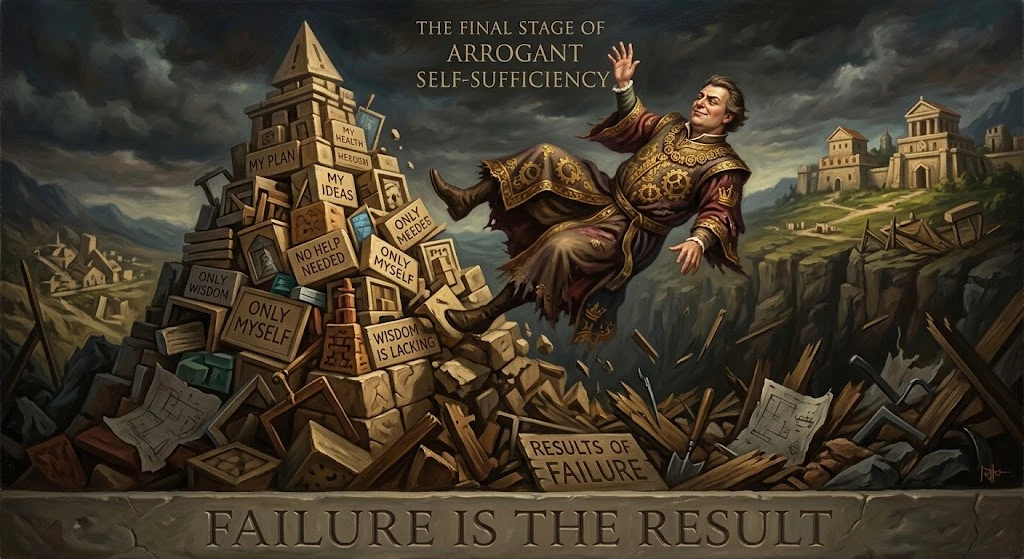
The Fallacy of Self-Dependence
The Fallacy of Self-Dependence
1 Corinthians 10:12: “Wherefore let him that thinketh he standeth take heed lest he fall.”
A Warning Against False Confidence
In this verse, Paul warns that there are two errors to avoid which lead to falling:
- Presumptive thinking
- Self-dependence: "he standeth" (took a stand and is still standing).
We must be aware of the error of presumptive thinking that leads to self-dependence opening the door to a catastrophic defeat.
Israel’s Example: Privilege Without Dependence
Before making this statement, Paul describes the actions and attitudes of the people of Israel after having experienced their marvelous redemption and liberation from the dominion of Egypt. He explains how the crossing of the Red Sea and the covering of the cloud were pictures of the baptism of the New Testament (Exodus 14) in which the Israelites became identified to Moses as their leader. Just as baptism is an identification with Jesus Christ rather than a saving sacrament, passing through the Red Sea identified Israel with Moses as the one who led them out of bondage after their redemption by the Passover lamb.
He reminded the Corinthian believers of how the Lord preserved the nation by providing their every need, from water to manna. Quail dropped from the sky and for forty years their shoes never wore out (Exodus 16; 17; Deuteronomy 8). Despite all the demonstration of God's presence and protection, they murmured seeking to fulfill their lusts and committed spiritual and physical fornication and adultery (Numbers 25).
Then later they saw a miraculous demonstration of God’s power in their favor by making the walls of Jericho fall with only their shout. The next city to be taken, Ai, was small and weak. They ignored the LORD and made their own plans confident that only thirty thousand were sufficient to take the city and suffered an embarrassing defeat (Joshua 7).
Two Truths Every Believer Must Remember
1. Redemption Does Not Make Us Immune to Error
With this exemplary reminder, Paul gives an admonition. He points the Corinthians to those events of the past that were recorded as examples to learn. He gave them two especially important truths. First, it is possible for us who have been redeemed and are under the protection and provision of the Lord to do the same errors as Israel. In his first letter, Paul warned Timothy, his “son in the Faith” saying, “Take heed unto thyself, and unto the doctrine…” (1 Timothy 4:16). Matthew also tells the story of Peter who said that he would die before he denied Jesus, and in less than twenty-four hours he denied Him three times (Matthew 26:35, 69-75). Paul’s warning to Timothy emphasizes the possibility, and Peter’s actions prove it.
2. Pride Makes Us Vulnerable
Secondly, we must avoid the dangerous attitude of pride. It is so easy to look at the errors of others and justify self. Those people should have understood what God had and was doing for them. They were ungrateful and egotistical. They should have known better.
Paul follows his warning with a simple but profound statement to the Corinthians. He says, "There hath no temptation taken you but such as is common to man". This means that no one is beyond falling into the same errors as the Israelites.
He continues with the statement by declaring that the only way to avoid falling into any error is to depend upon God. Paul says, "but God is faithful, who will not suffer you to be tempted above that ye are able; but will with the temptation also make a way to escape".
In other words, God knows all about the temptation and our weakness. He knows about the reality of temptation by experience in the Person of Jesus Christ. He also knows about how and why any specific temptation is affecting the believer. He then provides the way for victory.
God does not always remove the temptation but often shows how to defeat it. He thus turns a temptation to do wrong into a test proving the believer’s true level of faith. If I look to myself for the means of living a life above sin, there is no doubt that I will fall. However, if I recognize my tendency to commit sin and turn to the Lord, victory over the temptations that every single person faces in life is guaranteed.
Victory Comes Through Sustaining Grace
The real difficulty that the believer faces is not the temptation, but the submission to the Lord and dependence upon Him. When I try to be a good and faithful Christian thinking that I must achieve success and victory, sin will knock me to the ground before I know what has happened. It is His grace that saves and sustains us when tried or tempted.
Paul became discouraged by a physical illness. Three times he asked God to remove it, and three times his request was denied. Finally, God’s answered Paul with the key to victory: “My Grace Is Sufficient” (2 Corinthians 12:9).
He didn’t give Paul instruction or directions, but He gave him sustaining Grace. It was only after Paul received God’s sustaining grace that he was able to go on with no more discouragement and despair.
Conclusion: Depend Upon the Lord
If we try to confront our afflictions, temptations and responsibilities depending upon our own strength and knowledge, our defeat is assured. Therefore, before advancing toward what appears an easily won victory in our own abilities, let us fall on our faces before our Master to receive the necessary GRACE, either in strength or knowledge, that the Lord is providing for us.