
The Faithful Steward
The Faithful Steward
1 Corinthians 4:1-2 “Let a man so account of us, as of the ministers of Christ, and stewards of the mysteries of God. Moreover it is required in stewards, that a man be found faithful.”
Introduction
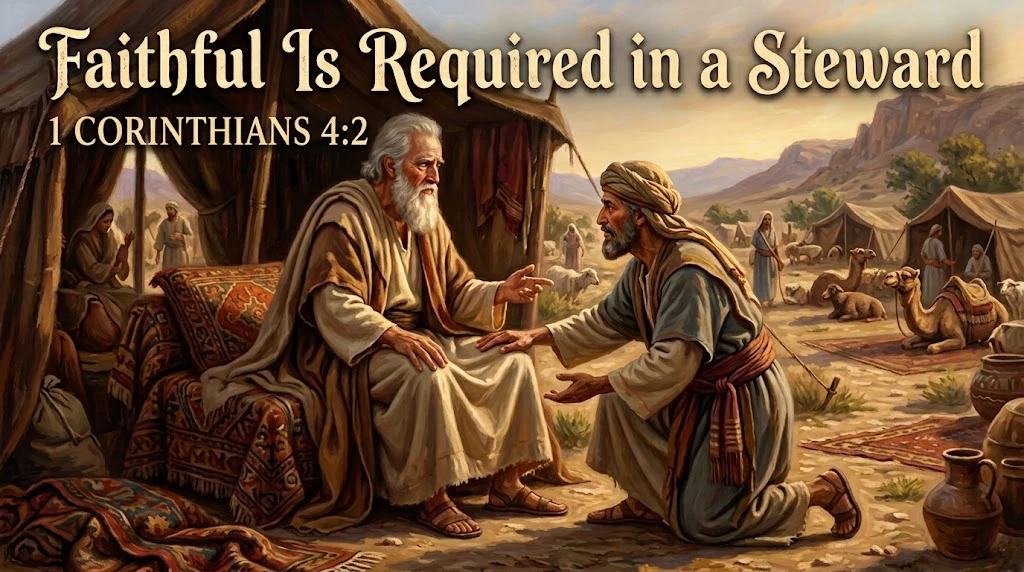
What is a Stewardship? It is to be entrusted with what belongs to someone else. In the Bible, the word steward refers to a servant entrusted with the responsibility of managing his master's estate. The best example of a steward is Abraham's servant to whom he entrusted all his possessions. He also gave him the responsibility of finding a wife for Isaac, his son (Genesis 24).
In our text, Paul declares that the only requirement of a steward is to be faithful (dependable). The servant Eliezer proved to be so faithful during his years of service to Abraham that he was given the most important responsibility of finding a wife for Isaac. The servant (Eliezer) was already the steward of all Abraham's material possessions (Genesis 24:2). It was his faithful stewardship that gave Abraham confidence to entrust his most precious possession to the custody of his servant. Certainly, Abraham had other servants capable of making a journey to Haran, but there was only one in whom Abraham trusted completely, Eliezer, because he had proven himself to be "faithful."
Paul’s Description of the Steward
Not everyone is a steward of Jesus Christ. There are specific requirements for person to be a steward of Jesus Christ. A person cannot just decide that he is going to be a steward. To be a steward, you must belong to Jesus Christ. Just before he begins his explanation of stewardship, Paul says to the Corinthians that they belong to Christ, "You (are) Christ's" (1 Corinthians 3:23). Jesus Christ has purchased them. He shed His own precious blood to pay our ransom from the slavery of sin and Satan (1 Peter 1:18-19). Paul describes this purchase in his letter to the Romans comparing it to the slave market, a terrible place (Romans 6:17-18). Calvary, the spiritual slave market, was cruel and ugly for men, but it was beautiful before God and wonderful to sinners.
Having been bought, we are now accountable to Christ our Master. We recognize this by formally presenting your body as a living sacrifice (Romans 12:1-2). Sin is no longer our legal master, and it has no right to rule over us. We can say no to sin and Satan and yes to the Lord (Romans 6:13). This formal submission means living in obedience to our master and makes our purpose in life to live for Christ (Galatians 2:20). Abraham's servant made a promise, with a formal ceremony, to fulfill his master's command: " Put, I pray thee, thy hand under my thigh: And I will make thee swear by the LORD, the God of heaven, and the God of the earth." (Genesis 24:2-3).
The Responsibility of the Steward
As stewards we are responsible to do the will of our Master. We answer only to Him, not even to ourselves. This does not mean that we do not consider others, but those considerations are always subject to the will of my Master (1 Corinthians 4:3-4). This means that we are concerned with what He has been placed under your care (1 Corinthians 4:1). We are to do the work of Christ as "ministers (servants) of Christ" and to administrate the “mysteries (revealed divine secrets) of God”. These include preaching the Gospel that brings salvation (Romans 1:16), teaching the doctrines of Scripture (1 Timothy 4:13, 16), and the discipleship of new believers so that they will know the doctrine and be able to pass it on to the next generation (Matthew 28:20; 2 Timothy 2:2).
Fulfilling these responsibilities requires faithfulness on the part of the steward. A good steward is dependable and trustworthy. He knows, understands and completes the work that his master has given to him. Paul says that this is the only requirement given to the Christian steward. This means that he is a faithful witness as Jesus commanded the disciples to be on the day of His ascension (Acts 1:8). Living a life that is directed and controlled by the Holy Spirit are general responsibilities given to every believer as a steward of Jesus Christ (Galatians 5:16-18; Ephesians 5:18). However, the Lord also has a specific purpose for every believer (Ephesians 2:10). That purpose or ministry is to be fulfilled within the ministry of the local church to which the believer belongs (Romans 12:4-8). The believer that is surrendered to the general and specific will of God will find it to be good, acceptable, and perfect (Romans 12:2).
The Resources of the Steward 1 Corinthians 4:7
As a steward, our Master has promised to supply all our needs (Philippians 4:19). It would be unjust for the Master to require faithfulness and not be Himself. Since we are serving Jesus Christ, He has bound Himself to take care of us. The fulfillment of God’s will does not depend upon who we are or what we have. The well know song "A Little Is Much When God Is In It" is a reality in the life of a faithful servant of God. Remember when God called Moses to go lead Israel out of Egypt. He asked Moses, "What is this in thy hand"? It was a simple tree branch (Exodus 4:2). During the ten plagues, when Moses raised his “tree branch”, the miracles took place. About 1600 years later, a young man gave his five loaves and two fish to Jesus who took them and fed over 20,000 people (John 6:9). While standing in the temple, Jesus saw a widow put two coins in the offering. That was her whole life saving, and Jesus said that she had given more than any other person in the temple (Mark 12:42-44).
The truth is that as stewards, everything we have is given to us by our Master to fulfill His will: this includes both the physical and the spiritual. He provides our daily physical needs (Matthew 6:25-33). Through the Holy Spirit, He provides the very tools and power to do the work for which we are responsible as He sees necessary (1 Corinthians 12:14). The Holy Spirit illuminates the mind of the believer to know and understand the purpose and will of God. He then gives the gifts necessary to do His will. He goes before opening and closing the circumstances necessary to move forward. Just as Abraham supplied everything for the trip and for the dowry of Isaac’s bride, our Master supplies everything necessary to do our responsibilities.
Conclusion
These truths should be like a GPS app or, for the old timers, a map. They should be the light that guides our lives as we remember who we were and what God has done for us. It is much easier to obey God's Word when we realize them. Whatever the Lord shows us to do, we must be immediately willing to act to fulfill His will.
When we follow the principle of stewardship, the Lord will do what is necessary so that we can, as His instruments do His wonderful works. The entire world has been talking about Charlie Kirk and the fabulous ministry he managed. The amazing thing is that he started with nothing but himself and God's direction. He did not even have a rod. He admitted that he had no idea what he was doing, he had no money, no equipment, no one to help. But he had God's command, and God gave him the resources he needed because he was the servant of Jesus Christ.
Whether you are a young man or an "old saint," there is no reason to not obey the Lord's command. He is the one who provides the resources and opens the doors. No one knows what the result of your obedience to the Lord will be. Your one-dollar missionary offering, your ten minutes of prayer, and your visiting for one hour will have eternal consequences. The surrender of your body and life to the ministry, whether part-time or full-time, will bring souls to Christ and prepare new believers to become guardians of all that God has given them. Therefore, be a faithful (trustworthy) steward of God.