
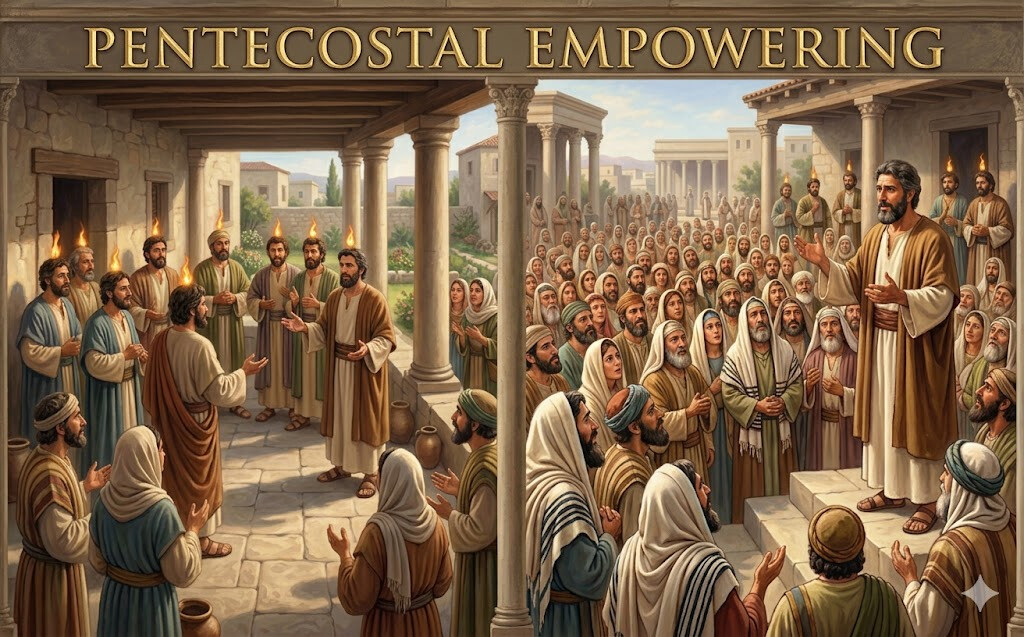
Pentecostal Empowering
Pentecost: Holy Spirit Empowerment
Text: Acts 2:1-4
“And when the day of Pentecost was fully come, they were all with one accord in one place. And suddenly there came a sound from heaven as of a rushing mighty wind, and it filled all the house where they were sitting. And there appeared unto them cloven tongues like as of fire, and it sat upon each of them. And they were all filled with the Holy Ghost, and began to speak with other tongues, as the Spirit gave them utterance.”
Pentecost stands as one of the most decisive moments in redemptive history. In Acts 2, the coming of the Holy Spirit marks not the beginning of salvation itself, but the inauguration of His permanent indwelling and empowering ministry in believers. To understand Pentecost rightly, we must hold together both its theological significance and its practical implications for the life of the church.
Introduction
Under the Ceremonial Law set up under the leadership of Moses, Israel was to celebrate seven feasts every year. These feasts took place at three separate times, and all males were supposed to go to Jerusalem to take part in the activities of those celebrations. The first three occurred in the first month of the Jewish calendar and were celebrated in a period of one week beginning on the fourteenth day of that month. These feasts took place at the end of the barley harvest and had great theological significance. The feast of the Passover was a memorial of the Passover meal and lamb which took place the night before the exodus from Egypt. The second feast called the Feast of Unleavened Bread began the next day a lasted one week. The third feast, Feast of First Fruits, took place on the third day after the Passover. On that day, sheafs of the first harvest of barley were waved before God in gratitude of His blessing of the harvest. It was during these three feasts that Jesus was crucified, buried and rose from the grave. He was and is the perfect Passover Lamb, the uncontaminated source of life, and the first fruit of the new and eternal life.
Fifty days after the Feast of the First Fruits, the fourth feast took place. This feast was called the Day of Pentecost occurring at the end of the harvest season. Loaves of leavened bread were taken and waved before God. Because they had leaven, they were not taken within the holy place but were eaten by the priests as a source of sustenance. It was the day of this feast that the Holy Spirit came upon the believers filling them with His presence and power in fulfillment of Jesus’ promise given before His ascension. According to the promise given the night before His death, Jesus said that the Comforter (Holy Spirit) would be sent to take His place as the administrator and capacitator of the lives and ministry of all believers. The ending of the wheat harvest made it possible to make the bread that was the sustainer of life. The process of reconciliation in Jesus Christ being completed was represented by this feast, and the constitution of the new life was established in the coming of the Holy Spirit to guarantee that new and eternal life and to empower the believer to fulfill all that pertained to that life.
The importance of what took place on that Day of Pentecost is both theological and practical. Theologically, the fulfilling of the promise of the Holy Spirit completed the process of reconciliation offered to all men and the empowerment for the new life in Jesus Christ. Practically, the events of that day prove God’s intentions and provisions for the life and ministry of every believer. Knowing the theological meaning is important, but that knowledge without the application of the practical aspects of the Day of Pentecost are the same as faith without works. The results are a dead Christianity incapable of accomplishing God’s purpose for salvation. Thus, it is important for the Christian to know and apply those practical aspects to his own life.
Obedient Unity
Ten days earlier outside of Bethany on Mount Olivet, Jesus had given instruction to the disciples to go to Jerusalem and wait for the coming of the promise of the Father, the Holy Spirit (Acts 1:4-5). Jesus spent forty days instructing the disciples of the fulfillment of the Old Testament prophecies in His life and death. There can be no doubt that the meaning of the Feast of Pentecost was included in that instruction. It was a picture of the fulfillment of the very promise Jesus had given to the disciples. Their gathering together that morning was with expectation of the fulfillment of that promise. Unlike the occasion where Thomas was absent on the day of Christ’s resurrection, they all were present and waiting. There is debate as to who this statement refers, there are people who say it refers just the apostles and others the hundred twenty believers. The phrase “they all” seems to show the presence of all the believers. The importance of the moment would constrain the presence of all the believers. The fact that the indwelling of the Holy Spirit is for all believers, not just a chosen few, also supports the inclusion of all believers. However, the most important fact is the unity of this group: “they were all with one accord in one place.” This unity was both in mental anticipation and in physical presence. There could no better description of the first “ecclesia” set up by Jesus in Jerusalem: the physical assembly of the group called out for a specific purpose. Although the local church does not have to be looking for the arrival of the Holy Spirit, the attitude shown by that first church should be the very essence of every local church today.
Manifestation and Result
The manifestation of the Holy Spirit on the Day of Pentecost had nothing to do with His divine presence in Jerusalem or in the world. Being God, He is ever present and active in every aspect of this universe. The special manifestation on that day showed the beginning of a new era in time, especially in relation to those saved by faith in Jesus Christ. It was not the beginning of salvation or of the church, but the beginning of a new ministry of the Holy Spirit. This new ministry meant the permanent indwelling and empowering of every believer in Jesus Christ. To begin this new ministry, the Lord marked the event with unusual and illustrative signs and consequences.
The Signs of the New Ministry
The signs were sudden and unforeseen by the disciples. The appearance of these signs was decided by God in type and in timing. Jesus told the disciples to wait but did not tell them the exact time. Neither did He tell them what to expect at the coming of the Holy Spirit. It would have been presumptuous for the disciples to insist on certain types of proof, and it is so today. Both the type and the means of the signs had purpose for believers and for the unbelievers. There was a rushing mighty sound that originated in the heavens and filled the house where the believers were gathered. At the same time, there appeared divided tongues that looked like fire. The sound was a means of directing the attention of the people in Jerusalem to where the Holy Spirit was indwelling the believers, and the divided tongues were the action that focused the attention of the observers upon the recipients of the special blessing. No one could doubt that there was a special showing of God’s power in that place.
The Miraculous Proclamation
As the crowd gathered they were all confused and marveled because what they heard from the disciples was miraculous. According to the text, the city was filled with men from every nation that had assembled for the feast day. There is a list of sixteen different nations given. According to the testimony of these foreigners, each one was hearing the message proclaimed by the disciples in their own native language. The message they were hearing was of the “wonderful works of God”. The whole situation left them amazed and unable to explain what they were seeing and hearing. The only explanation that someone could find was that these people were drunk and beside themselves. The real explanation was that the Holy Spirit had filled them with His presence and power to the point that He was in control and was giving them abilities beyond their normal capacity. Paul was obviously alluding to this very event when he told the Galatians that they should not be drunk with wine but be filled with the Spirit (Galatians 5:18). Notice that Paul did not refer to the actions of the disciples on Pentecost but to the source that caused the actions. As the disciples were completely controlled by the Holy Spirit to do what He said and what they could not do, we are to surrender to the Holy Spirit to allow Him to perform the actions He choses in His divine power. On the Day of Pentecost, the Holy Spirit’s purpose was to declare a message in a miraculous way to authenticate the divine authority of the speakers as the official representatives of the Lord through the local church.
The Powerful Explanation
While the crowd discussed among themselves what possible explanation could describe this event, Peter stepped forward and began to speak. We must remember that fifty-three days earlier, Peter had adamantly denied even know Jesus, not once but three times. On the day of the resurrection, he along with the other ten disciples were cowering in a room in utter fear of the Jewish authorities. Now he stepped forward and with complete confidence and authority proclaims the answer for which the crowd was looking for. He started out by denying that the cause of the preaching in the various languages was not wine, but the partial fulfillment of the declaration of Joel, “And it shall come to pass in the last days, saith God, I will pour out of my Spirit upon all flesh” (Joel 2:28). Peter was telling the people they were watching and hearing what the Holy Spirit of God was doing through the disciples. His beginning statement was an exhortation to listen with submissive ears to what was being said and what He was about to say because it was God, the Holy Spirit speaking. He quoted Joel’s words, “whosoever shall call on the name of the Lord shall be saved”, telling the crowd that those who listened and obeyed the message being given would receive the salvation of God. What was the message? Jesus of Nazareth whom they had taken “by wicked hands” and crucified was the Anointed One promised by God. Note Peter’s description of their action as being wicked because Jesus had proven Himself to be the Anointed One by a life of purity, divine power, and compassion. Peter wanted them to know that although their actions were part of God’s plan, their evil hearts were responsible for their actions.
Next, Peter told them how their actions of anger and evil had produced the very means of escape from the condemnation of hell. Jesus died, but God raised Him up from the dead just as David had prophesied in Psalm 16:8-11. Peter explained that David’s description could not apply to himself because his body was still in the tomb. Jesus, on the other hand, had come forth from the grave three days after His death of which the disciples were witnesses. He had ascended to heaven where He was gloriously exalted and in fulfillment of David’s prophecy was sitting at the right hand of God. The message preached from that day forward is that Jesus is both Lord and Christ. He is the fully authorized ruler (Matthew 28:18) and the Anointed priest providing the perfect sacrifice for sin. Peter finished his discourse saying that God had provided the promised Savior in Jesus Christ. Now, God sent the Holy Spirit of which the actions they were seeing and the words they were hearing were proof.
The Spectacular Result
In the beginning of the text, the Bible described these men as “devout” (God fearing) men. Hearing Peter’s message, their attitude changed from wonder to conviction. The word “pricked” means to be pierced. The Holy Spirit took the truth of the message and pierced the hearts of those who heard. Considering the truth of Peter’s message, they cried out, “What shall we do?”. Every preacher of the Word desires to hear these words because it reveals a tender and ready heart to receive the wonderful answer from God. Peter’s answer was, “Repent, and be baptized every one of you in the name of Jesus Christ for the remission of sins, and ye shall receive the gift of the Holy Ghost.” His answer had two requirements and two promises.
The first requirement is to repent. The word “repent” means to have change of mind and attitude best described as the order given to marching soldiers, “About face!”. The Jews had rejected Jesus as the Messiah who was offering them pardon of their sins and eternal life. As devout Jews, they believed that they did not need this message. Peter called their rejection “wicked” and determined having Jesus crucified. The call to repentance was a turning from the wicked rebellion and rejection of Jesus as the Anointed One sent by God in fulfillment of all the Old Testament prophecies to recognition and acceptance.
The second requirement is baptism. Peter was not saying that the act of baptism would save them, but the act of baptism was a visible declaration of their faith and identification with Jesus Christ. It was as Peter said, a recognition that the remission of their sin was in the Person and work of Jesus Christ. He had already declared that it was for this purpose that God had sent Him. Jesus’ death was decided before the foundation of the world (Revelation 13:8) and fulfilled every prophetic description given by the prophets of the Old Testament. The redemption and remission were an experience of the heart, and the baptism was a public proclamation of the new relationship in Christ.
The first promise was that of remission of sin. From the very first sin committed in the Garden of Eden until the moment of Jesus’ death on the cross, the only means of resolving the punishment of sin was the presentation of the blood of a substitutionary sacrifice. God affirmed this truth by setting up a system of ceremonial sacrifices in the law given by Moses. However, these sacrifices only gave temporary remission, making it necessary to have continual sacrifices. For these devout men, this was their only hope of remission. Peter’s message told them that the sacrificial death of Jesus brought perfect and eternal remission of sin. By repenting and receiving the sacrificial remission paid by Jesus Christ, the guilt of their sins would be eternally removed.
The second promise was the gift of the Holy Ghost (Spirit). Never had this promise been given as an immediate transaction. Old Testament prophecies told of the coming of this gift, but always as something future, never immediate. Peter’s message was that repentance and identification with Jesus Christ would bring the immediate reception of the eternal gift of the Holy Spirit. The presence of the Holy Spirit in the believer is a guarantee of eternal life (Ephesians 1:13-14). By the Holy Spirit, the believer receives a specific ministry (Romans 12:6-8) and the capacity to conduct that ministry (1 Corinthians 12). Although not recorded, the text says that Peter gave further explanation about these truths and concluded with a clear and pointed exhortation: “Save yourselves from this untoward generation.”
The Glorious Transformation
The rejection became reception as they believed the message being spoken in the power of the Holy Spirit by the disciples and Peter. They took their place alongside of the Jesus identifying with His death, burial and resurrection by baptism. They joined the ranks of the disciples in that first church in Jerusalem, increasing the number by three thousand. Their conversion led them to follow the teaching of the apostles that they had received directly from Jesus and remain firmly in fellowship with them in prayer and taking part in the Lord’s supper. This was the beginning of the work of Jesus Christ through the direction and power of the Holy Spirit. Within a brief time, another five thousand were added to the number of members of that first church. The power and conviction resulting from Holy Spirit controlled preaching and testimonies of the growing group of believers produced believers daily.
Conclusion
The event on the Day of Pentecost was an amazing and glorious event. Unlike some people believe, it was a onetime event with a unique purpose. To focus on the manifestations of the Holy Spirit on that day é to miss the divine purpose of the event. The principal truth of the record is His permanent coming into the life of every believer in Jesus Christ. The manifestations of His power are different in kind and purpose depending on the circumstances. Require the same manifestations as proof of superior spirituality is to misunderstand the purpose of the coming of the Holy Spirit and His gifts. The details of the consequences of the coming of the Holy Spirit are the focal point of the record of that day. The manifestations were temporary, but the conversions were permanent. The goal of the work of the Holy Spirit is always the conversion of souls. The manifestation of His power in any way is simply an instrument used to reach this goal. The redemptive work of Jesus Christ provided the redemption, remission and reconciliation. Since the Day of Pentecost, the presence and work of the Holy Spirit make the provision of Jesus Christ effective for all who repent and receive Jesus Christ as Lord and Savior. To make the manifestations the goal is to despise the person and the purpose of the presence of the Holy Spirit.