
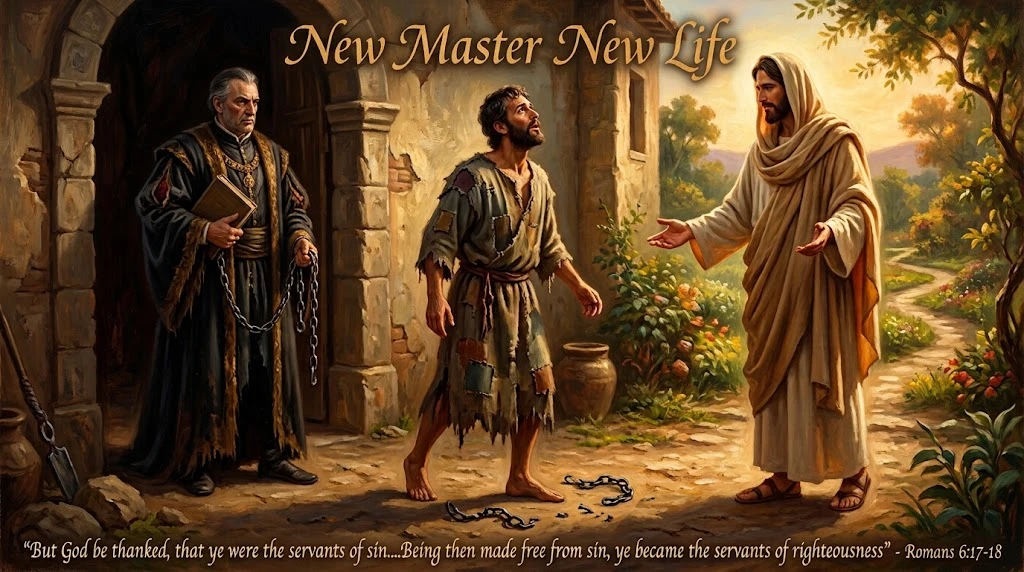
New Master New Life
A New Master Means a New Life
Freedom from Sin Because of Grace
Romans 6:14
Paul ends his discourse about the Christian’s liberty from sin giving a simple statement about the basis of the victory. Sin can no longer reign over the Christian because he is free from the judgment of the law. Grace has provided redemption and pardon from the guilt and the condemnation of the law. The motorist that is driving according to the traffic laws can freely pass a police officer and go on his way. However, the motorist that has violated just one law will sense guilt and have his journey interrupted by the officer who is enforcing the authority of the law. The Christian being justified by the righteousness of Jesus Christ is free to live his life within the precepts that have now become his source of obedience through the grace of God. Sin leads the sinner to break the law, but grace leads and capacitates the Christian to walk in the new life in Jesus Christ.
Freedom from the Law, Not Freedom to Sin
Romans 6:15
Paul repeats his question about continuing to commit sin but asks it in a unique way. His first reference to the question was if the Christian should keep on sinning so that grace could be more greatly manifest (abound). Only, this time he relates the question to freedom from the law. This question is related to the motive for gain. The idea is that the more I sin the more grace God gives. This second time, Paul moves the motive to liberty from the law. Since the Christian can no longer be condemned for sin, then he is free to follow his own desires and purposes in life. In both cases, Paul uses the strongest negation possible in the Greek language: “God forbid” or No; Never! It is important to understand that these two questions were not inquisitive, but rhetorical. He is using them to introduce a discussion about the logical answer.
The purpose of both the abundant supply of justifying and capacitating grace and the complete liberty from the condemnation of the law is to give the Christian the ability to live a life of submission to glorify God by doing His will.
Relationship Between Master and Slave
Romans 6:16
Paul adds another rhetorical question to the discussion introducing it with the phrase “Know ye not...”. He is not being inquisitive but is using the question to stir up the remembrance of the truth that he has already explained about the dominion of sin in the life of the sinner. He describes sin as a ruling master that reigns and controls the life of the sinner. Since the Christian is dead to sin by crucifixion, sin no longer has any authority over the life of the Christian. Therefore, Paul’s question reveals the contradiction of the idea of someone living a life of continual sin by using a metaphor for the roles of master and servant.
First, it is important to understand the meaning of the word translated servant as it is in the original Greek language. It is the word “slave”. Although the service is the same, there is truly a difference between a servant and a slave. A servant is one who is free to refuse the order given and is given a salary for doing the work. A slave receives no salary and has no right to refuse. The worst that can happen to a servant is to lose his job and salary. On the contrary, a slave could lose his very life.
Paul then compares sin and grace to masters. A master has absolute authority over the slave, meaning that only he has control. Therefore, the slave will submit (yield) only to his master. In this case, either to sin or to obedience or the grace of God. The result of yielding to sin is death. Notice that yielding to obedience does not produce life (salvation) but rather righteousness (moral goodness). Obedience does not produce life because that has already been given by the grace of God. The fact that grace is the master means that the sinner has been both justified and given salvation.
Another critical point made by Paul’s statement is that there is no shared authority. Either a person is a slave to sin, or he is a slave to grace. A slave to sin will not yield to the authority of grace, not will the slave to grace yield to the authority of sin. The issue of authority is settled by the purchase when the ownership is transferred by the purchase.
New Master Has Total Authority
Romans 6:17-22
Having settled the truth of the absolute authority of a master over his slave, Paul shows the unreasonableness of the idea of the Christian continuing to sin. He says, “Being then made free from sin, ye became the servants of righteousness.” He is confirming that having been freed from the master of sin, the Roman Christians automatically became the slaves of righteousness (correct moral living) by the transfer of authority. Jesus Christ paid the ransom price purchasing the sinner from the ownership and authority of sin as determined by the law and placing him under the absolute authority of obedience in grace. This takes place when the sinner believes and receives Jesus Christ as his personal Savior. The transaction is immediate and final. Just as one master takes immediate ownership of a slave from another master, the former master has no more authority over that slave.
Although the illustration he is using may seem to be a little offensive, it gives a clear picture of what Paul is trying to say. Just as we produced sinful and ungodly deeds by surrendering to the authority of sin, we should be surrendering to the authority of righteousness to a separated and pure life that glorifies our new Master. The fruit produced under the authority of sin is shameful and leads to the results of death. Righteousness has no part of the life of the sinner. Paul emphasizes this truth by saying that the sinner is “free from righteousness”. In contrast to being free from righteousness, the Christian is free from sin and empowered by grace to produce the fruit of holiness as well as taking possession of everlasting life. Note that there is fruit produced at the same time that eternal life is given by grace. So, Paul’s conclusive argument is that it is completely contradictory for a Christian who is the slave to grace and obedience unto righteousness could even think about living in sin. This goes along with John’s statement in 1 John 5:18 where he says, “We know that whosoever is born of God sinneth not...”. The verb “sinneth” means to continue living in sin.
Conclusion
Romans 6:23
Paul gives a conclusion to his explanation of the absurdity of a Christian continuing a sinful life having been bought as a slave to righteousness. He says, “For the wages of sin is death; but the gift of God is eternal life through Jesus Christ our Lord.” Notice the difference between the two masters. Sin pays wages that are gained by the sinner’s works: death. We can be sure that this master is both precise and punctual in his payment. Grace on the other hand freely gives eternal life to those who are without merit. The means by which this gift is made available and given is the Person and work of Jesus Christ who died, was buried and rose again to pay the redemption, provide perfect righteousness and share eternal life. This eternal life begins the moment of receiving God’s gift with a new nature that produces righteousness. It also places the Christian under the authority of Christ, his new and eternal owner.
Just one more thought, Christ will never put His purchased servant up for sale. To the contrary, He guarantees the eternal ownership with the divine sell of the Holy Spirit (Ephesians 1;13).