
Ancient Landmarks
Ancient Landmarks
Proverbs 22:28 "Remove not the ancient landmark, which thy fathers have set."
The Biblical Foundation of Ancient Landmarks
This proverb refers to the establishment of boundaries and prohibits their removal or change. Moses spoke of this law two times as he addressed the Israelites before they entered the promised land. The first time was an admonition and the second was a curse upon anyone who would remove the landmarks (Deuteronomy 19:14; 27:17). Proverbs 23:10 also deals with the same issue. Job 24:2 describes the removal of the landmarks as a criminal action. According to Moses' statement in Deuteronomy chapter 19, the basis of the command is the fact that the Lord God gave the land to the Israelites as an inheritance. After Israel entered and dominated the land, it was officially divided among the tribes with each family receiving its parcel of land. It was those divisions that having been marked from the very beginning were not to be removed or changed. Each parcel of land was a gift from God to the family that inherited it. For that reason, there was placed a divine curse on anyone who changed those landmarks. It was possible for one family to sell a part of their land to another family, but in the year of jubilee, the fiftieth year, all land was to be returned to their original owners. If a man died before giving birth to a child, a kinsman redeemer was to take the widow as his spouse to raise up an inheritor to possess the inheritance. By these two methods, every family was guaranteed to keep their inheritance.
Hosea’s Warning About Removed Boundaries
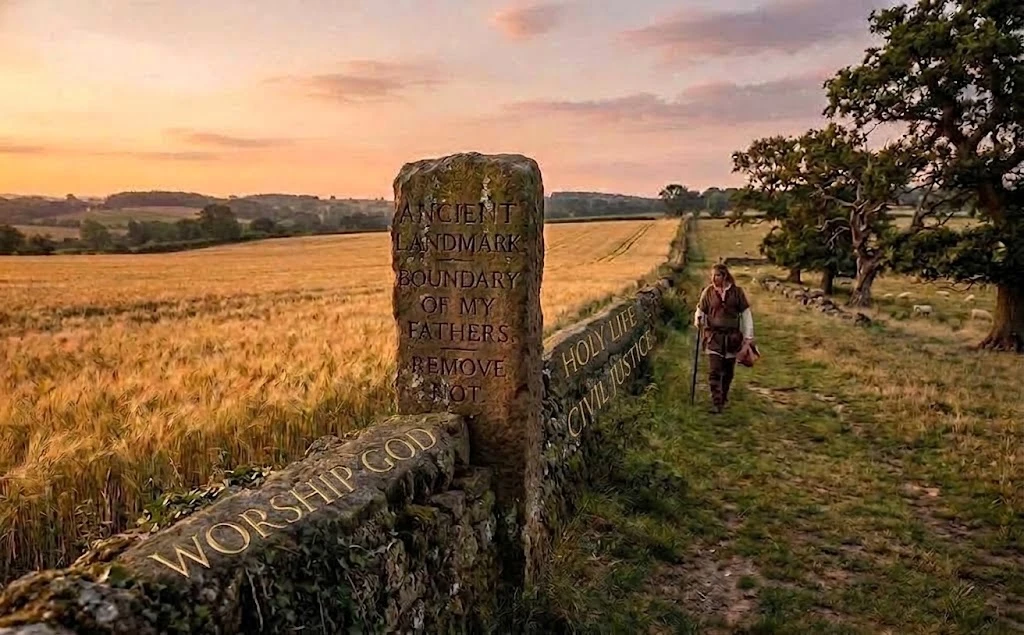
The prophet Hosea made a comparison of this command to the removal of spiritual and cultural boundaries given by God to His people. In chapter five of Hosea, God used His prophet to accuse the princes (political and religious leaders) of Israel of having removed the spiritual boundaries. The removal of those boundaries had affected the cultural and religious conditions of the nation. The boundaries of worship were removed, and the nation was worshipping false gods. The boundaries of sanctification were removed, and the nation was living in every type of wickedness. The boundaries of justice were removed, and the nation was filled with every type of crime and injustice imaginable. According to Hosea, the original boundaries were set up by God in His law given under Moses. The removal of these boundaries provoked the LORD to pronounce judgment upon Israel. Hosea said that God was going to pour out His wrath like water.
Why Are God’s Spiritual Boundaries Important?
First, the boundaries guarantee the inheritance and blessing of God. The truths, promises and instructions for a fruitful life for God are to be kept from generation to generation. Secondly, the boundaries are warnings against enemies and thieves. To cross those landmarks with the purpose of taking control of that which belongs to God's people results in determined opposition. Thirdly, the boundaries are promises of God's protection of His people. Those who try to defeat and change those boundaries will be judged by God's wrath. Even if they succeed in removing them, whether it be individually or collectively (the church), they can be assured that there will be divine judgment.
How Are the Landmarks Removed?
Hosea describes the removal of the spiritual boundaries in Israel. The Law of God was changed or ignored. The teachings and practices of false gods and culture were brought into the land leading to idolatry and immorality. Injustice became the basis of the society from the king on down. Pride became the characteristic of all leadership. Their children were strangers to the things of the inheritance of God, and God was an unknown personage to them.
How and When Did the Boundaries Begin to Be Removed?
The saddest truth of the history of Israel is that the boundaries began to be removed by King Solomon. This was the man who began his reign acknowledging his inability to rule putting his entire dependence upon the God of Israel. He was the king that built and dedicated the most beautiful temple of his day to the LORD God. He began to remove the boundaries by making alliances with idolatrous nations and marrying their idolatrous women. The final removal was slow in coming but once it started it was continuous. The end of the process was the removal of the ten tribes from the land never to have returned up to now. One hundred years later, Judah and Benjamin went into seventy years of captivity in Babylon, and although they returned to the land, the original spiritual boundaries were not completely restored. Worst of all, when the very One who could and will restore those boundaries appeared, they crucified Him.
Lessons for the Individual and the Church
First, the spiritual boundaries must be firmly set up in the individual and in the church. These boundaries are divinely established and recorded in the Word of God. They must be the basis of belief and practice. They are not to be increased as the Pharisees did with tradition or removed as the Sadducees did politically and philosophically. Secondly, these boundaries must be adhered to without the slightest deviation. We must remember that God's boundaries are for the guarantee of His blessing upon those whom He has given the inheritance as sons. Thirdly, the removal of those boundaries will bring a guaranteed judgment upon those that remove them and great loss and heartache to their posterity. It is not a light thing for a generation to decide to leave the biblical boundaries they have inherited from their parents. It is a more serious offense for a pastor or any other leader of a church to try to remove or change the boundaries originally set up for that church. To remove the boundaries is a criminal act of the thievery of the inheritance that God has given to His people.